
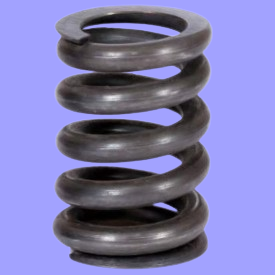
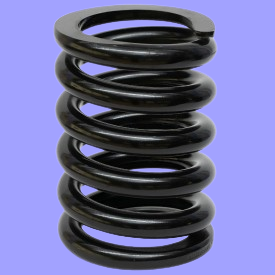
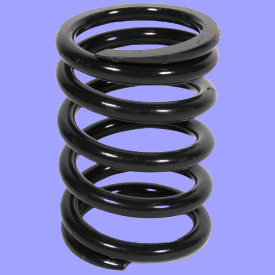
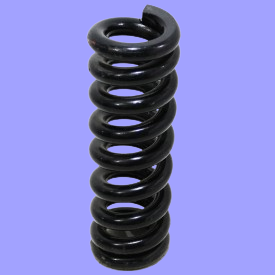
Actuator Compression Spring manufacturing capacity :
- Wire Dia. : upto 65 mm.
- Outer Dia. : upto 500 mm.
- Free Height : upto 1000 mm.
- Total Coils : As per user’s requirement.
- Load capacity : upto 40 Tons. (per pc.)
What is Actuator Compression Spring ?
An Actuator Compression Spring is a specific type of Spring designed to operate under compressive loads. It is typically characterized by its helical structure, which allows it to store and release mechanical energy as it is compressed and then returns to its original shape. Actuator Compression Spring plays a vital role in various mechanical systems, particularly in applications where controlled movement or force is essential.
The most common materials used for Actuator Compression Spring includes steel, stainless steel and sometimes specialized alloys, which provide the necessary mechanical strength and resilience. The choice of material directly influences the Spring’s performance, such as its yield strength and fatigue resistance. This makes material selection a critical aspect when designing Actuator Compression Springs for specific application.
One of the key distinctions between Actuator Compression Springs and other types of Springs, such as tension or torsion Springs, lies in their functionality. While Tension Springs are designed to resist pulling forces and Torsion Spring generates torque through twisting actions, Actuator Compression Springs excel in resisting compressive forces. This unique characteristic makes them particularly suited for applications such as valves, automotive components, and various industrial machinery where they facilitate linear motion or force resistance.
How Actuator Compression Spring works :
Actuator Compression Springs are critical components in various mechanical devices, designed to store and release energy efficiently. At their core, these Springs operate on the fundamental principles of elasticity and compression. When force is applied to a Compression Spring, it compresses, thereby storing potential energy. Once the applied force is removed, the spring returns to its original shape, releasing the stored energy in the process.
Actuator Compression Spring work on a straightforward principle: when a load is applied, the spring compresses, storing potential energy. This compression can generate a consistent pushing force, which is vital for operations such as opening a valve or engaging a mechanism. The amount of force generated is proportional to the degree of compression, which is defined by Hooke’s Law. Understanding this relationship is crucial for selecting the right spring for specific applications.
The mechanics of Actuator Compression Springs rely on Hooke’s Law, which states that the force exerted by the Spring is proportional to its displacement. This linear relationship means that the more a Compression Spring is compressed, the more force it will exert when returning to its neutral state. This characteristic makes Actuator Compression Springs indispensable in applications requiring controlled movement and force regulation.
Benefits of using Actuator Compression Spring :
Actuator Compression Spring have a vital role in various mechanical and engineering applications, bringing numerous benefits that enhance system performance and longevity. One of the primary advantages of employing these springs is their exceptional durability. Designed to withstand heavy loads and frequently executed cycles, actuator compression springs maintain structural integrity and performance over prolonged periods, ultimately leading to reduced maintenance costs and downtime.
In addition to durability, efficiency is another significant benefit of Actuator Compression Springs. These Springs effectively store and release energy in a controlled manner, allowing for precise manipulation of force and movement. This characteristic is crucial in applications where consistent performance is required, such as in automated machinery or vehicles. Their ability to absorb shock effectively also positions Actuator Compression Springs as a reliable solution for dynamic applications, mitigating potential damage to components and ensuring smoother operation.
Cost-effectiveness further enhances the appeal of Actuator Compression Springs. As they can be manufactured from various materials and tailored to specific requirements, these Springs are often less costly than alternative solutions. The relatively simple design of Actuator Compression Springs facilitates easier and more economical production, making them accessible for both small-scale and large-scale manufacturing processes. Their adaptability allows engineers to select Springs that meet particular project needs without incurring prohibitive costs.
Why Actuator Compression Spring is necessary :
Actuator Compression Spring contributes to both functionality and safety in Actuator. These Springs are designed to store and release energy, making them essential components also in numerous applications, including automotive, aerospace, and industrial machinery. Their ability to absorb shock and provide resistance allows machinery to operate smoothly and efficiently.
One key function of Actuator Compression Spring is to maintain the proper spacing between moving parts in mechanical assemblies. By doing so, they prevent parts from coming into contact with one another, which can lead to wear and potential failure of the system. This is particularly important in applications where precision is paramount, such as in hydraulic systems or machinery with tight tolerances.
Moreover, Actuator Compression Spring enhances the safety of machinery. In scenarios where load-bearing components experience force beyond their designed parameters, these Springs can act as a buffer, absorbing excess energy and mitigating risks of catastrophic failure. Thus, their integration is crucial in high-stress applications where the safety of workers and equipment is at stake.
Furthermore, Actuator Compression Spring facilitate the return motion of moving parts. They provide the necessary force to return a part to its original position after compression has occurred. This characteristic is vital in mechanisms such as clutches, gear shifts, and braking systems. Without proper Springs, these systems can fail to operate correctly, leading to performance issues and potentially dangerous situations.